


Choosing an SEO agency is one of those decisions that sounds simple until you’re sitting across from your third sales pitch of the week, being shown the same slide deck with different logos on it. I’ve been in the industry long enough to have worked at a large agencies like WME Group and Mindshare (part of GroupM), run a boutique one, and watched clients get burned by both. So let me give you the honest version of this comparison, not the one that flatters us.
The short answer: it depends on what your business actually needs. The longer answer is below.
WHAT YOU’RE ACTUALLY BUYING WITH A BIG AGENCY
Large digital marketing agencies, the ones with 100+ staff, offices in three cities, and a client roster that includes household names, have real advantages. Their processes are documented. Their reporting infrastructure is often excellent. They have specialists for almost every sub-discipline, and if you’re a business spending $50,000+ per month on digital marketing, the structure they offer can be genuinely valuable.
They also carry credibility. For some businesses, listed companies, enterprise brands, businesses that need to report upward, the name recognition of a big agency matters. That’s a legitimate consideration, not a vanity one.
But here’s what the pitch doesn’t tell you: once you sign, your account almost certainly gets handed to someone junior. Not always, but often. The senior strategist who sold you the work moves on to the next pitch. Your day-to-day contact is a 24-year-old account manager working across eight clients simultaneously, escalating questions to someone who’s barely looked at your account that month.
I’ve seen it from the inside. I’ve also had it confirmed by almost every client who came to us after leaving a large agency.
The model isn’t broken by accident. Large agencies are built for scale, which means they need repeatable processes and layered account structures. The problem is that SEO, real SEO, requires genuine strategic thinking that doesn’t fit neatly into a tiered account team.
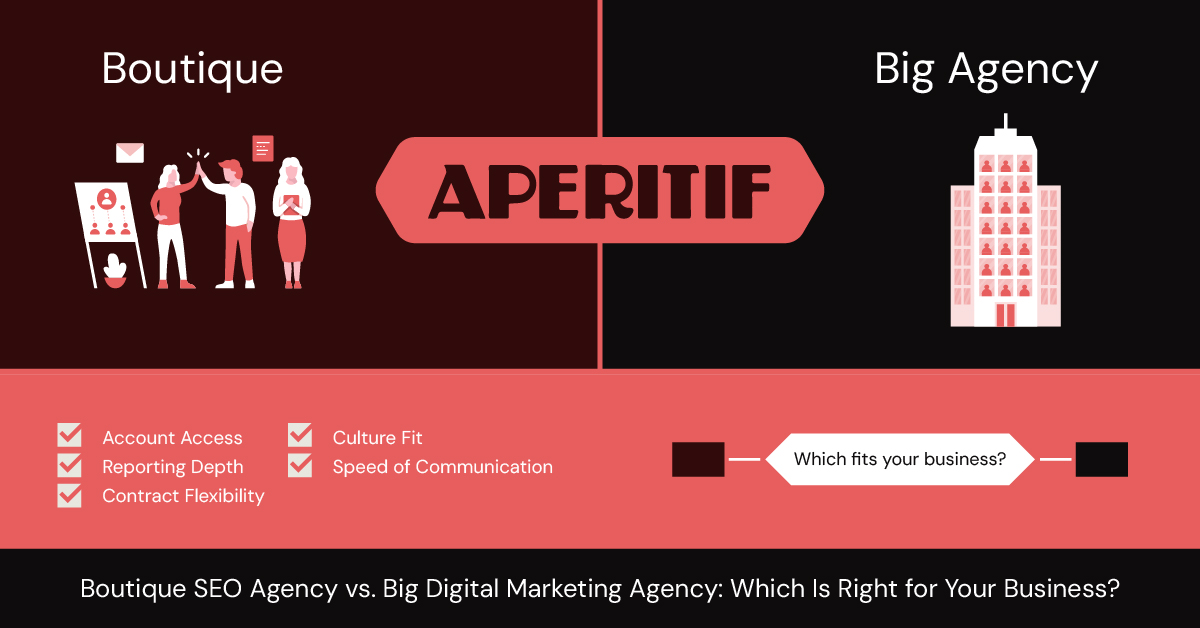
WHAT BOUTIQUE ACTUALLY MEANS (AND WHAT IT DOESN’T)
“Boutique” gets thrown around by agencies of all sizes as a marketing line. So let me be direct about what it means when it’s genuine.
A genuine boutique agency is one where the senior people do the work. At Aperitif, the person who scopes your strategy is the same person who implements it. When you email us, you hear back from someone who actually knows your account, not a project manager who has to ask three people before replying.
That accountability changes the quality of work. When the strategist writing your content brief is also watching your rankings move every week, the feedback loop is tight. Problems get caught faster. Pivots happen in days, not in the next quarterly review. No game of telephone.
The trade-off is real, though. A boutique agency typically has a narrower team. If your business suddenly needs heavy paid media, brand strategy, and influencer management all at once, we’re probably not the right fit to run all of it. We know what we’re good at and we don’t pretend otherwise but will help you find reliable partners who can fill in the gaps.
Boutique also means capacity limits. A well-run small agency is deliberate about how many clients they take on. If that means a waiting list, that’s actually a good sign, which means they’re not overselling. But it does mean you may not get started immediately.

WHERE EACH MODEL ACTUALLY WINS
Big agencies win when:
– You’re spending significant budget across multiple channels and need a single team coordinating everything
– You need enterprise-grade reporting and can benefit from their tech stack
– Internal stakeholders require the reassurance of a recognisable agency name
– Your account genuinely is large enough to command senior attention (think $50k+ per month)
Boutique agencies win when:
– You want to talk to the person doing the work, not a relay system
– Speed of execution matters, and decisions and changes happen without committee approval
– Your business is specific enough to need genuine strategic thought rather than templated deliverables
– You’ve been burned by previous agencies and need accountability built into the relationship
One thing I’d push back on: the idea that boutique means cheaper. Good boutique work from experienced people isn’t cheap. What you’re paying for is the concentration of senior time on your account, not a cost-per-deliverable model.
THE ACCOUNT MANAGEMENT PROBLEM
This deserves its own section because it’s the single biggest source of client frustration I hear.
At large agencies, the person with the seniority and expertise to make good strategic decisions is almost always working on multiple accounts at the director or head-of level. Below them, account managers coordinate delivery. Below them, specialists execute tasks. The result is that strategic decisions take time to filter down, and the person actually touching your website may be several layers removed from your business goals.
When something goes wrong, whether a traffic drop, an algorithm update, or a technical issue, the response time in that model can be dangerously slow. By the time the account manager has flagged the issue, had it escalated, and received a response from someone senior enough to diagnose it, weeks can pass.
I experienced this first-hand when a large automotive client came to us with a significant (70%!) organic traffic drop after launching a new site, that despite the client escalating, didn’t seem to be addressed. Low and behold, we quickly realised that a proper SEO migration was not completed, meaning a lof of authority from the previous URL structures was not flowing through.
In a boutique model, the strategist is watching your data directly. There’s no relay. That’s not a small difference.

WHAT TO ASK BEFORE YOU SIGN ANYTHING
Whether you’re talking to a big agency or a small one, these questions will tell you more than any pitch deck:
Who will actually be working on my account week to week, and what is their experience level?
Can I meet that person before I sign?
What does your reporting look like, and what does it tell me beyond rankings and traffic?
How do you handle communication: what’s the turnaround on emails, and who do I escalate to if I have a problem?
What happens if my account manager leaves?
The answers to those questions are more revealing than anything in a proposal. A good agency, of any size, should be able to answer them clearly.
My Honest Verdict
If you’re running a professional services business, a law firm, an accounting practice, a mortgage brokerage, where individual client relationships drive revenue and SEO is a primary growth lever, a boutique agency where senior people work your account is almost always the better choice.
If you’re a mid-market business with significant multi-channel spend and internal teams who can manage agency relationships, a large agency’s infrastructure might genuinely suit you.
Most businesses I talk to think they need the big agency but actually need the boutique. The pitch is impressive. The day-to-day reality is usually less so.
We’re a boutique SEO agency based in Melbourne. We work with professional services businesses across Australia and we do it with senior people who care about results. If that sounds like what you’re looking for, the conversation starts at aperitifagency.com.au.