



Google has officially confirmed the rollout and completion of its March 2026 Spam Update
The update began rolling out on March 24 and was confirmed as complete by Search Engine Journal in under 24 hours – making it one of the quickest spam updates Google has ever shipped.
Google didn’t bother with a grand announcement or policy update. Instead, they moved quickly against sites that have been pushing the SEO boundaries with dodgy tactics.
A Notably Fast Rollout
It’s worth putting it in context just how fast this rollout was.
Previous spam updates have run anywhere from a week to a month. This one was done before most people in Australia had finished their Tuesday morning coffee.
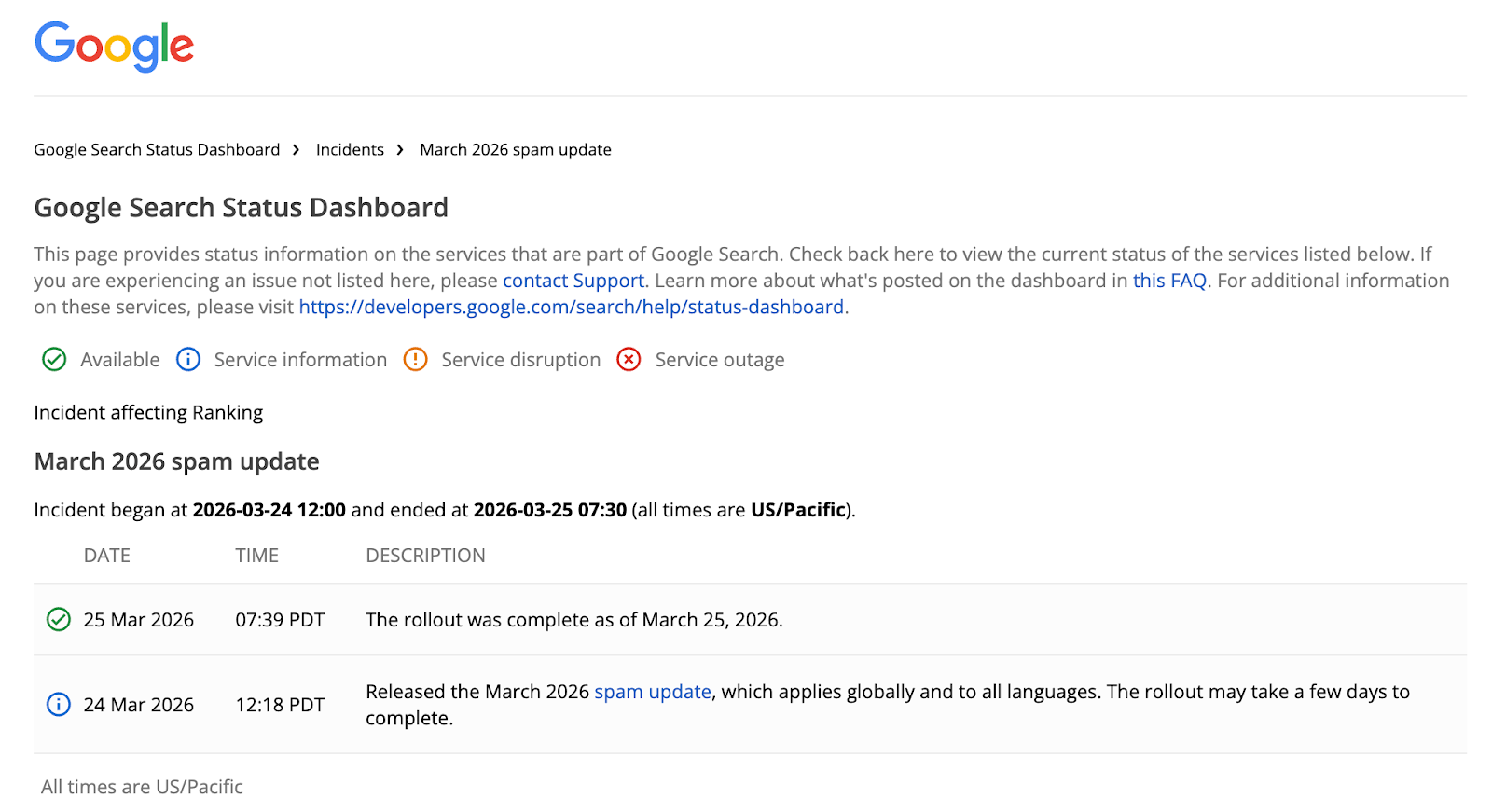
According to Google’s Search Status Dashboard:
- Started: March 24 – 12:00 PM PT (March 25 – 7:00 AM AEDT)
- Completed: March 25 – ~7:30 AM PT (March 26 – ~2:30 AM AEDT)
- Total rollout window: Under 20 hours
Compare that to recent history:
| Update | Duration |
| August 2025 Spam Update | ~27 days |
| December 2024 Spam Update | ~7 days |
| March 2026 Spam Update | Under 20 hours |
What Kind of Update Is This?
It’s important to be clear about the distinction: this is a spam update, not a core update. The two are meaningfully different.
Core updates reassess how Google evaluates content quality across the board – they can cause significant ranking shifts even for sites that haven’t done anything wrong. Spam updates are enforcement actions.
According to Google’s own documentation, they’re powered by systems like SpamBrain and are designed to identify sites actively violating spam policies – then reduce or remove their visibility accordingly.
No new spam policies were announced alongside this update. Google is enforcing rules that have been on the books for some time. If you’ve been operating within those guidelines, you’re unlikely to see meaningful movement.
What Google Is Actually Targeting
Based on Google’s known spam policies and the enforcement trends we’ve seen over the past 12–18 months, here’s where this update is almost certainly focused:
Scaled AI Content Abuse
There’s nothing inherently wrong with using AI to help produce content, but Google has been explicit that scaled content produced at volume without genuine value is a problem. This includes mass-produced AI pages, programmatic SEO builds that generate hundreds of templated pages with minimal differentiation, and content that reads as if it were written to fill a keyword slot rather than help a person.
Example: A travel site that uses AI to auto-generate 5,000 pages like “Best things to do in [City]” – each structured identically, pulling from the same data sources, with no local knowledge, original photography, or human editorial input. The pages rank briefly, then collapse when Google catches up.
Parasite SEO
Parasite SEO involves publishing content on high-authority, trusted domains, think news sites, university platforms, or established media outlets, with the sole purpose of borrowing that authority to rank for competitive keywords. It’s a tactic that exploits the trust Google extends to established domains, and one Google has been tightening enforcement around considerably over the past year.
Example: A gambling affiliate pays a regional newspaper to publish a “Best Online Casinos in Australia” article on their domain. The newspaper has high authority; the content has nothing to do with their usual coverage. The article ranks quickly because of the domain, not because it’s useful.
Expired Domain Abuse
Buying expired domains to exploit their residual link equity is a long-standing grey-area tactic – and one Google has become significantly better at identifying. Strategies that use bulk 301 redirects to funnel authority, or rebuild sites on expired domains purely for SEO gain, are firmly in the crosshairs.
Example: An SEO operator buys an expired domain that previously belonged to a respected legal directory. Rather than rebuilding it as a genuine resource, they 301 redirect all URLs to their own site to pass through the accumulated link equity, or rebuild it as a thin affiliate site in a completely unrelated niche.
Spammy Backlinks & Private Blog Networks (PBNs)
Private blog networks, collections of websites built or acquired purely to manufacture links, remain one of Google’s primary targets. At the same time, spammy backlink profiles acquired through link farms, mass directory submissions, or paid link schemes continue to attract penalties.
Example: An agency builds 50 low-effort blogs across different niches, each with a handful of generic articles and links pointing to a client’s site. The network looks like diverse, independent websites – but they share hosting, ownership, and linking patterns that SpamBrain is trained to recognise.
Cloaking & Doorway Pages
Cloaking means showing different content to Google’s crawlers than you show to actual visitors, usually to make spammy or thin content appear valuable. Doorway pages are designed solely to rank for a keyword and then funnel users elsewhere, rather than providing any standalone value.
Example: A site presents a well-structured, content-rich page to Googlebot, but actual visitors are immediately redirected to a heavily monetised affiliate page with little editorial value. The page exists purely to intercept organic traffic, not to genuinely serve searchers.
Thin Affiliate Content
Affiliate sites aren’t inherently problematic, but pages that exist solely to insert affiliate links, with no original research, testing, or insight added, have long been on Google’s radar. The question Google’s systems are trying to answer is: Does this page add anything that isn’t already available from the merchant directly?
Example: A “best VPN” roundup that rewrites the vendor’s own marketing copy, inserts affiliate links, and adds no independent testing, real-world data, or comparative analysis. It looks like a review, but the author has never used any of the products.
How to Read Your Data Right Now
The rollout is already complete, meaning you can assess the impact today.
- Look at the window from March 24–25 in Google Search Console
- Pay attention to clicks, impressions, and page-level visibility.
Spam updates tend to be more targeted than core updates.
You’re more likely to see sharp drops on specific pages, particularly in affiliate-heavy, programmatically-generated, or third-party-hosted content, rather than your whole website taking a hit.
Clean, brand-led sites with genuine content typically sail through these untouched.
Recovery from a spam penalty is slower than from a core update. Because Google needs to see sustained compliance – not just a flurry of fixes – meaningful recovery typically takes months, not weeks.
What You Should Do Now
Whether you saw movement or not, this update is a good way to pressure-test your current approach. Here’s where to focus:
- Audit your low-quality and AI-generated content. Review pages that exist to target keywords rather than genuinely help users. AI content isn’t automatically a problem, but content produced at scale without editorial input, original perspective, or real usefulness is a liability.
- Review your backlink profile. Look at your inbound links in Ahrefs or Search Console. If you’ve historically acquired links through networks, paid placements, or bulk outreach, now’s the time to assess which of those are worth disavowing
- Audit redirect and domain strategies. If you’ve purchased expired domains or run large-scale 301 redirect strategies, understand how those look to Google. Redirects that exist purely to pass link equity – rather than serving users following old links – are increasingly flagged
- Add real depth to your content. The best defence against any spam or quality update is content that genuinely reflects expertise, real experience, and useful insight. That means first-hand knowledge, original data where possible, and clear authorship – all core tenets of Google’s E-E-A-T framework.
- Consolidate and strengthen your topical coverage. Overlapping or duplicate content dilutes your authority. Find the best version of each page and consolidate others around it, supported by strong internal linking.
- Invest in brand signals, not just rankings. Are you building something people seek out directly? Mentions, reviews, coverage, and genuine audience growth are increasingly important inputs. hey can’t be gamed the way links once could.
- Reach out to an SEO Agency. If you took a hit, they can diagnose what triggered it and map the recovery. And if you came through unscathed? They can spot vulnerabilities and find growth opportunities.
What This Update Tells Us
- The speed of this rollout is arguably more revealing than the update itself. Google didn’t spend weeks carefully testing this – they executed it in under 20 hours. That suggests a high degree of confidence in their detection systems and a willingness to act decisively.
- There’s no more warning windows. Also signals that the window between “Google starts noticing a tactic” and “Google acts on it” is closing. What might have run for years without consequence is now being caught and acted on in a single overnight window.
- E-E-A-T matter more than ever. The direction of travel is clear: spam tactics get removed faster, scaled low-value content carries increasing risk, and the sites that continue to perform well are those that have built genuine authority, clear expertise, and real trust with their audiences.
- Shortcuts never win. If your strategy still leans on shortcuts, the gap between where you are and where Google is heading is narrowing fast. If you’re building something genuine, you’re operating in exactly the territory Google is trying to reward.
Get started on a growth plan
Find out where you stand. We’ll audit your site for free and walk you through the good, the vulnerable and the untapped potential.
We’ll tell it to you straight. You’ll get a clear picture of where your site performs and a practical growth plan, whether that’s addressing penalties or finding new opportunities.